Short Answer
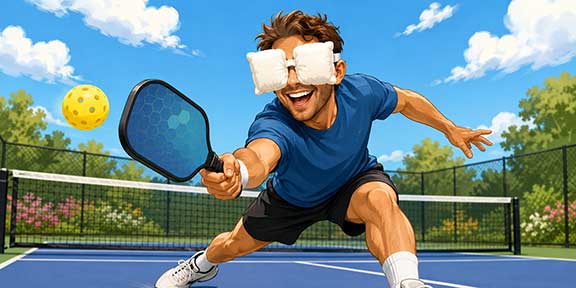
Soft eyes in pickleball means seeing the ball without staring at it too hard. Instead of narrowing your focus and tightening your body, soft eyes allow you to see the ball, the court, your opponent, your partner, and the space around the point. From the Fluid Motion Factor perspective, soft eyes help the body move and respond more naturally.
The Problem With Trying Too Hard to See the Ball
Every pickleball player has been told to watch the ball.
This is good advice, in the same way that “breathe oxygen” is good advice. It is hard to argue with. The trouble begins when players turn watching the ball into a kind of visual emergency.
They stare.
They squint.
They lock on.
They bear down.
They try to look the ball into obedience.
The result is often not better vision. It is more tension.
The face tightens. The neck tightens. The shoulders rise. The grip gets heavier. The paddle starts to feel less like a tool and more like a piece of courtroom evidence. The player is watching the ball, yes, but in a way that makes the whole body less responsive.
That is where the idea of soft eyes becomes useful.
Soft eyes are not lazy eyes. They are not vague eyes. They are not the eyes of someone trying to remember where he left his reading glasses.
Soft eyes are receptive eyes.
They let the ball come into awareness without squeezing the rest of the court out of existence.
Soft Eyes vs. Hard Eyes
Hard eyes narrow the world.
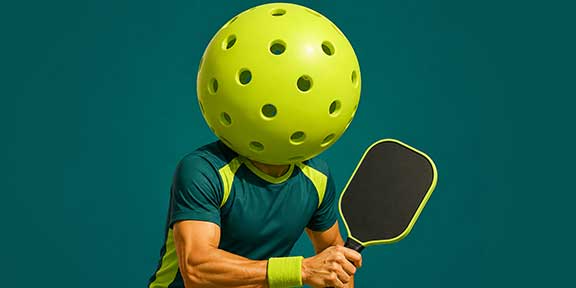
When players use hard eyes, they often focus intensely on the ball in a way that shuts down peripheral awareness. The ball becomes the only object in the universe. Unfortunately, pickleball is not played in a universe with only one object.
There are opponents.
There is a partner.
There is court position.
There is paddle position.
There is open space.
There is the kitchen line, quietly waiting for someone to step on it and begin a small legal proceeding.
Hard eyes can make a player late because the body receives less information. The player may see the ball but miss the situation.
Soft eyes widen the world.
With soft eyes, you still see the ball, but you also sense what is happening around the ball. You notice the opponent’s paddle. You feel the spacing. You sense whether the ball is attackable, neutral, or something that should be treated with the delicacy of a sleeping cat.
This wider awareness helps the body prepare earlier and respond more naturally.
Why Soft Eyes Matter in the Fluid Motion Factor
From the Fluid Motion Factor perspective, the problem in pickleball is often not a lack of effort. Many players are trying very hard. Sometimes heroically hard. Sometimes in a way that should require a permit.
The problem is interference.
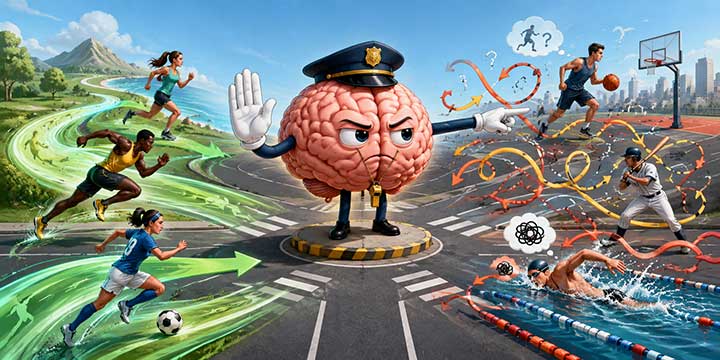
The thinking mind steps in and starts supervising movement. It wants to control the shot, prevent the mistake, correct the last error, and manage the future. Under pressure, that supervising mind often gets louder.
Soft eyes help quiet that process.
When the eyes soften, the body often softens too. The grip loosens. The shoulders drop. The breath becomes easier. The player is less likely to force the ball and more likely to receive it.
That word matters: receive.
A player with hard eyes often attacks the ball mentally before it arrives. A player with soft eyes lets the ball declare itself.
How fast is it coming?
How high is it?
Is it dipping?
Is it floating?
Is it attackable?
Does it need a soft hand?
Can it be redirected?
These questions do not need to be answered in sentences. The body can often read them faster than the mind can explain them.
Soft eyes allow that reading to happen.
Soft Eyes Help You Feel Time
One of the strange things about soft eyes is that they can make the game feel slower.
Of course the ball is not actually slower. The plastic has not become philosophical. The opponent has not suddenly agreed to be more considerate.
What changes is the player’s state.
When the eyes are hard and the body is tense, everything feels sudden. The ball jumps. The hand reacts late. The feet get stuck. The player feels rushed and then tries to hurry, which is generally how the circus begins.
With soft eyes, the body often receives information earlier. The player sees more of the play developing. The opponent’s paddle position registers. The ball’s arc is clearer. The court does not vanish.
That creates a little more room.
Not a lot. Pickleball is still pickleball. But sometimes a little room is enough.
Enough to soften a block.
Enough to let a dink drop.
Enough to avoid attacking a low ball.
Enough to reset instead of panic.
Soft eyes do not give you more time on the clock. They help you waste less of the time you already have.
Soft Eyes at the Kitchen Line
The kitchen line is where soft eyes may matter most.
At the kitchen, players often get jumpy. A ball can be sped up. A dink can be disguised. A volley exchange can turn into a paddle duel that looks, from the outside, like four people trying to swat invisible bees.
Hard eyes make that worse.
When a player stares too narrowly, quick exchanges feel chaotic. The body reacts from tension instead of awareness. The hand gets grabby. The paddle moves too much. Balls pop up, sail long, or get punched into the net with impressive sincerity.
Soft eyes allow the player to sense more than the ball.
You see the opponent’s paddle face.
You sense whether the ball is rising or falling.
You feel whether the shot requires touch or firmness.
You notice where the open space might be.
You stay connected to your partner’s position.
At the kitchen, soft eyes help turn reaction into response.
That is a major difference.
Reaction is startled.
Response is organized.
Soft Eyes and the Dink Game
Dinking is often treated as a technical skill, and of course it is. Paddle angle matters. Contact point matters. Grip pressure matters. Footwork matters.
But the dink game is also a test of visual and bodily calm.
A player with hard eyes may try to place every dink perfectly. That effort often makes the ball too high, too stiff, or too obvious. The player is trying to control touch, which is a little like trying to control a soap bubble with a hammer.
Soft eyes make dinking feel more like receiving and returning.
You let the ball come.
You feel it on the paddle.
You send it back with shape.
You stay aware of the whole pattern.
The dink becomes less of a command and more of a conversation.
This does not mean you dink without intention. You can still aim crosscourt, move the opponent, protect the middle, or wait for a ball to attack. But the intention rides on top of feel instead of replacing it.
That is the FMF difference.
Soft Eyes and Pressure
Pressure tends to harden the eyes.
At 2-2, a player may see the ball naturally. At 9-9, the same player may stare at the ball like it has just delivered bad news from a distant government office.
Why?
Because pressure invites control. The mind wants certainty. It wants to prevent mistakes. It wants to make sure nothing embarrassing happens in front of partners, opponents, friends, spouses, strangers, folding chairs, and possibly one judgmental dog near the fence.
But the more the player tries to control the ball, the less fluid the body becomes.
Soft eyes are a way back.
They give the player a simple cue under pressure:
See the ball.
See the court.
Let the body respond.
Not five instructions. Not a full technical renovation. Not a tragic monologue about the last miss.
Just soft eyes.
That may sound too small. But under pressure, small is often exactly what the body can use.
A Simple Way to Practice Soft Eyes
You can practice soft eyes during ordinary play.
Before a serve return, look at the server and the ball without narrowing your gaze. Feel your feet. Let your face relax. Notice the space around the server, not just the ball.
During a dink rally, try to keep awareness broad enough that you can sense both the ball and the opponent’s paddle.
At the kitchen line, notice whether your eyes tighten when the ball speeds up. If they do, do not scold yourself. Just soften again.
Between points, take one breath and let your vision widen.
The cue can be very simple:
Soft eyes. Easy hand. Receive the ball.
That is enough to begin.
What Soft Eyes Are Not
Soft eyes do not mean you stop watching the ball.
This is worth saying because someone will always take a perfectly useful idea and drive it into the decorative shrubbery.
Soft eyes do not mean you look away.
Soft eyes do not mean you drift.
Soft eyes do not mean you play vaguely.
Soft eyes do not mean you ignore technique.
Soft eyes do not mean you become so relaxed that your partner begins checking for a pulse.
Soft eyes mean you see with less strain and more awareness.
You are still engaged. Still alert. Still competitive. Still trying to play smart pickleball.
You are simply not trying to squeeze performance out of your eyeballs.
Soft Eyes Help the Body Answer
The larger purpose of soft eyes is not just better vision. It is better movement.
When the eyes soften, the body has a better chance to organize itself. The hand can feel. The feet can adjust. The paddle can respond. The mind can stop turning every ball into a committee meeting.
From the Fluid Motion Factor point of view, this is central.
The body does not need endless verbal instruction during a point. It needs useful information and enough freedom to act on it.
Soft eyes provide that information.
They help the player see the ball without losing the game around it.
Final Thought
Soft eyes in pickleball are a simple way to reduce tension, widen awareness, and let the body respond more naturally. They help players stop forcing the ball and start receiving it.
The next time you feel rushed, tight, or overinstructed, do not add another command.
Try softening your eyes.
Let the court come back into view.
Let the ball arrive.
Let the paddle feel it.
Let the body answer.
That is where soft eyes begin.
And in a game as quick, odd, delicate, and occasionally ridiculous as pickleball, that small shift can change everything.
Suggested FAQ Questions
- What does “soft eyes” mean in pickleball?
- How are soft eyes different from watching the ball?
- Can soft eyes help me stop overthinking during pickleball?
- How do soft eyes help at the kitchen line?
- Do soft eyes help with dinking and touch shots?
- How can I practice soft eyes during a pickleball game?
FAQ:
What does “soft eyes” mean in pickleball?
It’s a different way of paying attention. We rest our vision on the entire visible space in front of us, not just focussing on the pickleball.
How are soft eyes different from watching the ball?
The ball is a single point of focus. Soft eyes tales in context - the position of the ball in space, your opponents, the court, all factors in the point.
Can soft eyes help me stop overthinking during pickleball?
If you are doing it, there isn’t room for other thoughts. You can’t actually have multiple thoughts at the same time.
How do soft eyes help at the kitchen line?
By softening the eyes, the prefrontal cortex tends to go offline. That takes out a half second of mental processing from the equation. You need that half second because that is also how long it takes the pickleball to travel kitchen line to kitchen line. Your cerebellum takes over, and your speed to shot goes a lot faster and with more spatial awareness of where the ball ins and where to hit. It’s a magical upgrade, really surprising.
Do soft eyes help with dinking and touch shots?
For sure because they both flourish in an environment of receptivity and calm.
How can I practice soft eyes during a pickleball game?
There is no practice. Just do. Soft eyes is a play technique, not something to “try” in practice


0 Comments