How do I stop overthinking in pickleball?
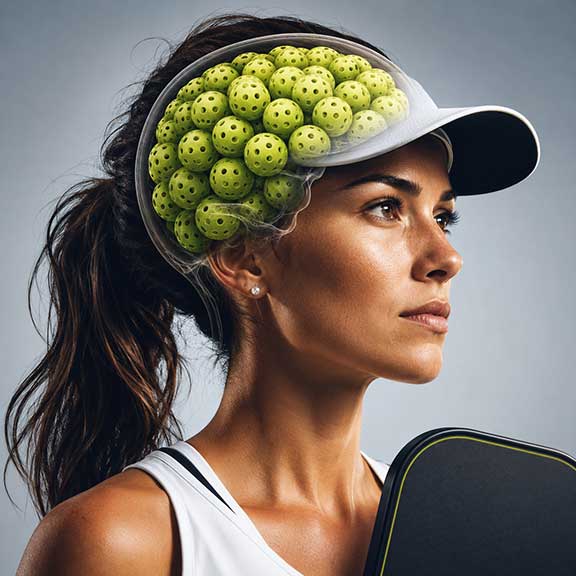
To stop overthinking in pickleball consider ANY thinking to be overrated. You are not being paid to think the ball, but to hit it. You are going to hit it with a paddle that is attached to your hand, which is performing a physical function that you have done hundreds of times. Repeated physical functions are controlled by the highly capable, super-fast cerebellum. Thinking is more typical of the prefrontal cortex (PFC), which deals with time and self-image (and does all that processing slowly).
Think of how easy it is for you to pick up a spoon and use it. That is an automatic function. It adds nothing to the excellence of your spooning to intensely supervise and judge it.
You simply don’t want that hyper-attached shouting supervisor (PFC) involved in your pickleball shots. Maybe between shots, but hardly even then. Between games is better.
We do offer stuff for your thinker-brain to do during the shot. It’s good to keep it at least occupied, so it doesn’t butt in with urgent instructions: But none of the stuff-to-do formulas has “over” in front of “thinking.”
What to do instead
The Nines
The Nines: consider quietly counting the number nine inside as the ball is hit and as it comes toward you.
Acknowledge the ball
Simplu acknowlegde the incoming ball, rather than intensely focussing on it
Pause before conact
Just as the ball reaches you, find a moment o pause, just before the hit
Soft eyes
Soften the vision: Have your attention on the whole field of vision (and the ball)
FAQ:
How do I stop thinking about mechanics during a point?
Give your brain something else to do something simple like thinking the number nine, as described above. Mechanics have nothing to do with hitting a ball. That’s the kind of stuff you do in between games when you’re trying to establish muscle memory. During the point just let the muscles remember, without cranial interference
What should I focus on right before I hit the ball?
We talked about focusing on a moment of silence just before hitting. That’s a good thing to try out.
Why does trying harder sometimes make me play worse?
Trying has nothing to do with playing. Those two words don’t even belong in the same sentence. Trying is indicative of prefrontal cortex activation. What we want is for the cerebellum to be in charge, because it can make all kinds of micro adjustments the last second. But none of that happens if you’re trying.
What does “acknowledge the ball” mean instead of “watch the ball”?
“Acknowledge the ball” implies a much more relaxed relationship with the ball. “Watch the ball” requires a focused attention, which is likely to involve prefrontal cortex activation. Acknowledge the ball allows us to have a broad awareness, including environmental factors, your position in space, and keeps you from giving your body orders that made sense at the time, but no longer make sense by the time the ball is hit.
How can a pause before contact help my shot?
Because it is easy for our attention to drift towards the target, even when we have not actually made contact. The moment of contact is crucial, and full attention there is far more important and structures the actual result that intention can only wish for.
How do I stay calm when the score gets close?
Deciding that the real win is within, (and maintaining that intention) is most likely to support outer success. If you win but were agitated the entire time until the end, is that really a win? Why not enjoy the entire process either way (and probably win more that way).
Related Blog Posts
Why Thinking Too Much Hurts Your Pickleball Game
The Short Answer: Thinking too much hurts your pickleball game because it interrupts the body’s natural timing, feel, balance, and reaction. From the Fluid Motion Factor perspective, overthinking puts the verbal, supervising mind in charge of movements that the body…
Why the Brain Interferes With Natural Athletic Movement
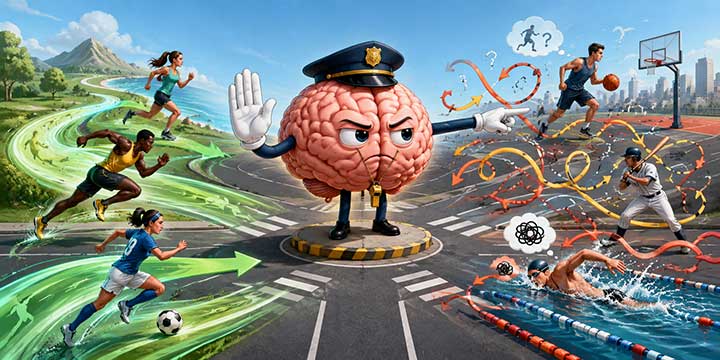
Short Answer The brain interferes with natural athletic movement when the conscious, thinking mind tries to control actions the body normally performs automatically. In pickleball, this often happens under pressure, after mistakes, or when a player tries too hard to…
Why Your Pickleball Game Tightens Up
Why Your Pickleball Game Tightens Up: Approval, Control, Safety, and the Supervisory Brain Most pickleball players know this feeling. One game, your touch is there. The reset drops softly into the kitchen. Your third-shot drop feels feathered rather than forced. Your…
Freedom
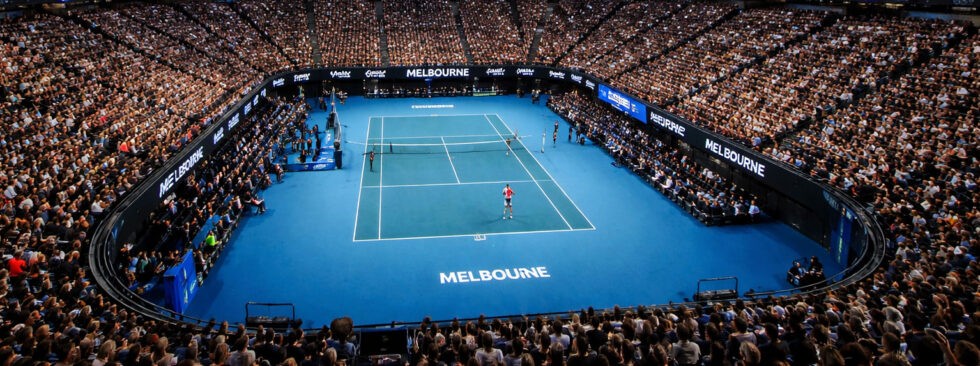
I’ve been watching the Australian Open (tennis) this week and what I saw I see in all sports. What separates the players that do the best, including Carlos Alcarez the winner, is the level of freedom they have during key points. In any tennis match there are five or…

The Ghost Ball
Strong intermediate athletes in racquet and paddle sports often run into a frustrating pattern: the swing feels fine, the intention is clear, and the contact still comes out slightly off. One reason can be visual, not mechanical. In the final instant before contact,…