Short Answer
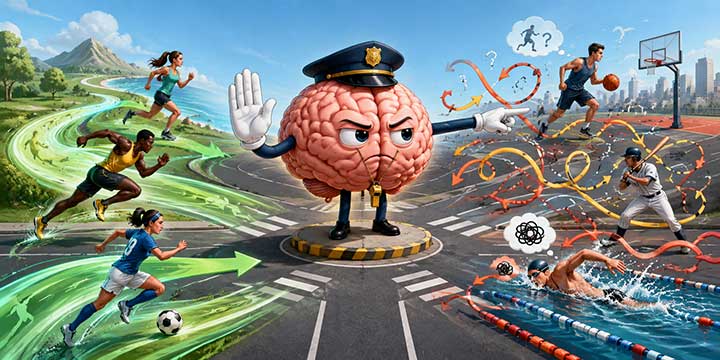
The brain interferes with natural athletic movement when the conscious, thinking mind tries to control actions the body normally performs automatically. In pickleball, this often happens under pressure, after mistakes, or when a player tries too hard to “do it right.” From the Fluid Motion Factor perspective, the problem is not thinking itself. The problem is thinking at the wrong time, in the wrong way, while the body is trying to move.
The Brain Is Helpful, Until It Becomes the Supervisor
The brain is a wonderful thing.
It can plan vacations, write novels, remember grudges from 1987, and convince you that buying a new paddle will solve what is clearly a spiritual problem.
It can also learn patterns, understand strategy, read opponents, and help you improve your pickleball game.
So the issue is not that the brain is bad.
The issue is that one part of the brain sometimes applies for the wrong job.
In sports, especially in a fast, timing-based game like pickleball, a great deal of movement happens below the level of conscious thought. Your eyes, feet, hand, paddle face, balance, spacing, and timing are all working together in a rapid, coordinated system. The body is making tiny adjustments faster than the verbal mind can explain them.
Then the thinking mind steps in.
“Keep your paddle up.”
“Bend your knees.”
“Watch the ball.”
“Don’t miss.”
“Soft hands.”
“Move your feet.”
“Why did you miss the last one?”
“Have you considered becoming a calmer and more impressive person?”
The body was trying to play a point.
The brain has started a staff meeting.
Natural Movement Is Too Fast for Verbal Control
Pickleball may look gentle from a distance, especially to people who have never been personally attacked by a speed-up at the kitchen line.
But during a rally, the game is quick.
The ball changes speed, height, spin, and direction. Your feet adjust. Your paddle face changes. Your balance shifts. Your eyes gather information. Your hand manages pressure. Your body decides whether to block, dink, drive, reset, roll, let it go, or simply survive with dignity.
The conscious mind cannot micromanage all of this in real time.
That is not an insult to the conscious mind. It has other talents. It can make plans, understand ideas, and decide whether the postgame snack situation is adequate.
But it is not built to consciously calculate every inch of movement while the ball is already arriving.
Athletic movement depends on trained coordination. The body learns through repetition, rhythm, vision, feel, timing, and experience. It stores patterns. It predicts. It adjusts.
When you are playing well, you are not absent. You are aware. But you are not translating every movement into words.
You see.
You move.
You respond.
That is natural athletic movement.
Interference Begins When the Mind Wants a Guarantee
The thinking mind often interferes because it wants certainty.
It wants to make sure the serve goes in.
Make sure the dink stays low.
Make sure the return is deep.
Make sure the put-away is not missed.
Make sure your partner does not make that small wounded face that somehow contains an entire marital counseling session.
The problem is that sports do not offer guarantees.
When the mind tries to guarantee an outcome, it often adds control. It tightens the grip. It narrows the eyes. It rushes the feet. It steers the paddle. It checks the motion during contact.
That extra control may feel responsible, but it often disrupts the movement.
This is why players sometimes miss easy shots. The easy shot gives the mind time to interfere.
A hard shot may force the body to react naturally. A floating ball, on the other hand, gives the thinking mind a chance to walk in wearing a little managerial badge.
“Here is a ball we should definitely not miss.”
And now the shot has become a referendum.
That is where trouble begins.
The Conscious Mind Is Useful Before and After the Point
From the Fluid Motion Factor perspective, the goal is not to turn off the brain.
That would be unwise, especially if someone asks the score and you would rather not invent a number.
The goal is to use the thinking mind at the right time.
Before the point, the mind can set an intention.
“Deep return.”
“Make them dink.”
“Watch the middle.”
“Serve with rhythm.”
After the point, the mind can reflect.
“I rushed that.”
“They are attacking my backhand.”
“We are leaving the middle open.”
“I may have tried to hit a winner from a ball that had all the dignity of wet laundry.”
That kind of thinking can help.
But during the point, the mind often needs to become quieter. It can offer a simple cue, but it should not try to drive the whole movement.
A good working rule is:
Think between points. Receive during points.
That does not mean you are empty-headed while playing. It means your attention is on the ball, the court, the feel, the space, and the movement, not on a running commentary about mechanics and consequences.
Why Overthinking Changes the Body
Thought is not just thought.
In sports, thought becomes physical.
A worried thought can tighten the hand.
A critical thought can freeze the feet.
A fearful thought can shorten the swing.
A busy thought can narrow vision.
A self-conscious thought can make the body feel as if it is moving under courtroom lighting.
This is why overthinking is not merely a mental inconvenience. It changes the quality of movement.
The body starts to lose rhythm. Touch gets stiff. The paddle becomes less responsive. The player may rush, steer, lunge, poke, or decelerate through the shot.
From the outside, it may look like a technical mistake.
And sometimes it is.
But often the technical mistake is the visible symptom of interference.
The player did not suddenly forget how to hit the ball. The player lost access to the movement because the conscious mind got in the way.
Soft Eyes Reduce Interference
One of the simplest ways to reduce brain interference is to soften the eyes.
Players are often told to “watch the ball,” which is good advice, except that many players interpret it as “stare at the ball as if it owes you money.”
Hard visual focus can create tension. It narrows awareness. The ball becomes everything, and the court disappears.
Soft eyes are different.
Soft eyes allow the ball to be seen clearly while the wider court remains present. You see the ball, but you also sense the net, your partner, your opponent, the kitchen line, the open space, and the rhythm of the point.
Soft eyes give the body more information.
They also give the thinking mind less reason to panic.
When awareness widens, the player is less likely to feel trapped inside one tiny emergency. The point becomes a field of movement again, rather than a crisis centered on a single yellow object with holes in it.
Acknowledge the Ball Instead of Attacking It Mentally
Another FMF phrase that helps reduce interference is:
Acknowledge the ball.
This is not the same as staring. It is not the same as forcing concentration. It is not the same as giving yourself a lecture on paddle angle while the ball approaches.
To acknowledge the ball is to let it register.
You receive it into awareness.
The body can then organize around it.
The ball does not need a speech. It does not need your anxiety, your autobiography, or your thoughts about what will happen if you miss. It does not need to be interrogated.
It needs to be received.
When you acknowledge the ball, you return to the present event.
Not the last mistake.
Not the possible future score.
Not the internal courtroom.
This ball.
That is where natural movement can begin again.
The Pause Gives the Body Room
The pause is another way to reduce interference.
This is not a dramatic pause. Nobody should freeze in the middle of a rally like a statue waiting for funding.
The pause is a tiny moment of inner quiet before contact.
It is the moment when the player stops rushing, stops grabbing, and lets the body settle into the shot.
Many athletic errors happen because the mind gets ahead of the body. The player is already thinking about the result before contact has happened.
The pause brings attention back to the meeting point between paddle and ball.
It can soften the hand.
It can steady the feet.
It can reduce the lunge.
It can let the paddle meet the ball instead of ambushing it.
In FMF terms, the pause is not an extra piece of technique. It is a way of removing interference.
Why Pressure Makes Interference Worse
Pressure invites the thinking mind to take over.
At 2-2, a serve may feel simple. At 10-10, the same serve suddenly looks as if it has been assigned historical significance.
The score gets loud.
The future gets loud.
The fear of missing gets loud.
And when things get loud, the mind tries to help by controlling more.
Unfortunately, that is often exactly when the body needs more freedom, not less.
This is why pressure can make players tighten up. It is not always because they lack courage. It is because pressure has shifted control toward conscious management.
The body knows how to serve.
The body knows how to dink.
The body knows how to return.
But under pressure, the mind wants proof. It wants insurance. It wants a receipt.
Sports do not work that way.
The better response is not more control.
It is simpler attention.
Soft eyes.
Easy hands.
Acknowledge the ball.
Find the pause.
Let the body respond.
The Brain Learns by Getting Out of Its Own Way
This may sound odd, but the brain is still involved when the thinking mind gets quieter.
The whole system is involved.
The visual system, balance system, motor system, memory, prediction, rhythm, and timing are all part of the brain-body network. Natural movement is not brainless. It is deeply intelligent.
It is just not always verbal.
That distinction matters.
Many players think they have to choose between being thoughtful and being natural. They do not.
You can learn intelligently, practice deliberately, and still play with less conscious interference.
In fact, that is the ideal.
Use the thinking mind to learn.
Use the body to play.
Then use the thinking mind again afterward to reflect.
This is not anti-intellectual.
It is good job placement.
A Simple FMF Reset for Brain Interference
When you feel your brain interfering during a match, try this:
- Notice it without drama: “I’m overcontrolling.”
- Take one easy breath.
- Soften your eyes.
- Loosen your grip.
- Feel your feet.
- Acknowledge the ball.
- Use one cue.
Good cues include:
- Smooth.
- Easy hands.
- Wait.
- Receive.
- See it.
- Let it happen.
- New ball.
Do not use all of them.
This is not a buffet.
Pick one.
The purpose of the cue is to return attention to the experience of playing, not to give the mind more furniture to rearrange.
Natural Movement Is Not Magic
Natural athletic movement can sound mysterious, but it is not magic.
It is what happens when trained systems are allowed to work.
A musician does not consciously calculate every finger movement during a performance.
A driver does not narrate every steering adjustment.
A good pickleball player does not need to issue a full instruction manual to the shoulder, wrist, knees, eyes, and paddle face before every dink.
Training matters.
Technique matters.
Repetition matters.
But at some point, the body needs access to what it has learned.
That access is what interference blocks.
And that access is what FMF tries to restore.
The Real Goal: Let the Body Rejoin the Game
The brain interferes with natural athletic movement when it tries to control what it should be supporting.
The conscious mind wants to help. It wants to protect you from mistakes. It wants to guarantee the outcome. It wants to keep you from embarrassment, defeat, and possibly your partner’s silent disapproval.
But in the middle of a point, help can become interference.
The better goal is not to banish the mind. It is to let the mind become quieter, simpler, and better timed.
Think before the point.
Receive during the point.
Reflect after the point.
When the thinking mind stops trying to seize the controls, the body can rejoin the game.
And that is when pickleball begins to feel natural again.
FAQ:
Why does the brain interfere with athletic movement?
The brain interferes when the conscious mind tries to control movements that the body normally handles automatically. This often happens under pressure, after mistakes, or when a player tries too hard to be technically perfect during a point.
Is thinking bad for pickleball?
No. Thinking is useful before and after points. It helps with learning, strategy, and reflection. The problem comes when the player tries to consciously manage paddle angle, timing, footwork, touch, and outcome while the ball is already arriving.
How do soft eyes reduce brain interference?
Soft eyes widen awareness. Instead of staring tensely at the ball, you allow the ball and the court to remain present together. This gives the body more useful information and reduces the urge for the thinking mind to micromanage the shot.
Why do I play worse when I concentrate harder?
Concentrating harder can sometimes create tension and narrow awareness. If concentration turns into overcontrol, the body may lose timing, touch, and rhythm. From the FMF perspective, better play often comes from simpler, softer attention rather than more mental effort.
What should I do when I start overthinking during a match?
Use a physical reset: breathe, loosen your grip, soften your eyes, feel your feet, and acknowledge the ball. Then use one short cue such as “smooth,” “wait,” “easy hands,” or “receive.”
Does natural athletic movement mean ignoring technique?
No. Technique matters in practice and learning. But during play, the goal is to access technique rather than consciously recite it. Natural movement happens when trained skills can operate without constant interruption from the thinking mind.


0 Comments