The Short Answer:
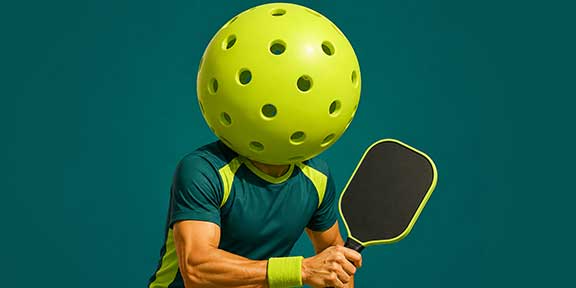
Thinking too much hurts your pickleball game because it interrupts the body’s natural timing, feel, balance, and reaction. From the Fluid Motion Factor perspective, overthinking puts the verbal, supervising mind in charge of movements that the body often handles better through rhythm, awareness, and feel.
The Little Coach in Your Head
There is a certain kind of pickleball point that invites the mind to become very busy.
You miss an easy dink. You pop up a reset. You serve into the net. You drive a ball that should have been dropped. You let a ball go that lands in by approximately the width of a congressional promise.
And then the little coach in your head arrives.
Keep your paddle up.
Move your feet.
Don’t miss the next one.
Stay calm.
Hit it deeper.
Watch the ball.
No, really watch the ball.
Why are you like this?
The intention may be good. The result often is not.
The more instructions you give yourself during a point, the more your movement tends to tighten. Your hand becomes careful. Your feet hesitate. Your eyes narrow. Your paddle starts steering instead of swinging.
This is one of the great pickleball puzzles: the player is trying harder, but playing worse.
From the Fluid Motion Factor perspective, that is not surprising. Thinking too much often puts the wrong part of the brain in charge at the wrong time.
Pickleball Is Too Fast for a Committee Meeting
Pickleball is not slow enough for long verbal processing.
At the kitchen line, the ball may come back quickly. It may be sped up, blocked, rolled, dinked, lobbed, or redirected. Your body has to make tiny adjustments almost instantly.
The thinking mind is useful, but it is not always fast enough for that job.
By the time the mind says, “I should probably keep this low and aim crosscourt because their backhand looks weaker,” the ball has already arrived, met your paddle, and filed a complaint with management.
Good pickleball often happens before we can fully explain it.
You see the ball.
You sense the pace.
You feel the contact.
You adjust.
That does not mean you are not intelligent. It means your intelligence is not only verbal. It is also in your eyes, hands, feet, balance, timing, and awareness.
Overthinking Creates Physical Tension
Thinking too much is not just a mental issue. It becomes physical.
A worried thought tightens the hand.
A critical thought stiffens the shoulder.
A fearful thought stops the feet.
An anxious thought narrows the eyes.
The body listens to the mind more than we sometimes realize. When the mind says, “Don’t miss,” the body often hears danger. It braces. It gets cautious. It tries to guide the ball safely.
That is where trouble begins.
A guided dink often floats.
A careful serve often loses rhythm.
A cautious return often lands short.
A forced volley often sails long.
The player thinks the problem is technique. Sometimes it is. But very often the technique is being distorted by tension.
FMF looks at that tension and asks: What would happen if the body were allowed to play without so much supervision?
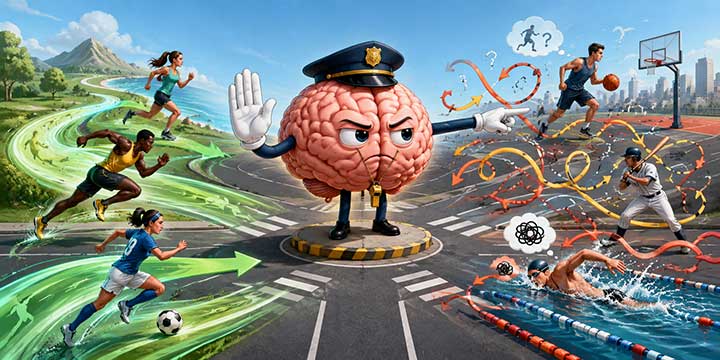
The Supervising Mind Can Break the Natural Link
In good pickleball, there is a natural connection between seeing and moving. The ball comes, the player receives the information, and the body begins to organize the response.
Overthinking inserts a middleman.
The ball comes.
You see it.
The mind comments on it.
The mind remembers the last mistake.
The mind issues three corrections.
The body waits.
The shot is late.
This is how players get jammed, rushed, stiff, or tentative. They have not lost all ability. They have interrupted the pathway between perception and action.
It is the athletic version of a computer buffering at exactly the wrong moment.
“Watch the Ball” Can Become Too Much Watching
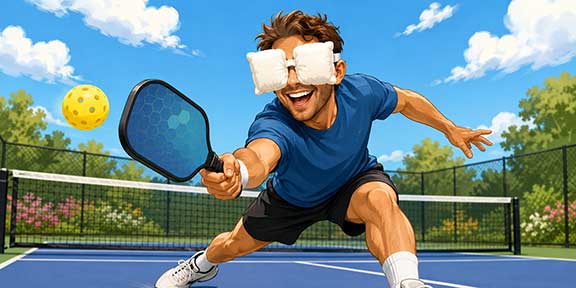
Of course players need to see the ball. But many players turn “watch the ball” into hard staring.
They try to lock onto the ball with intense, narrow focus. Their eyes get tight. Their body gets tight. The rest of the court disappears.
That is a problem in pickleball because the ball is only part of the picture.
You also need to sense opponent position, partner movement, open space, paddle angles, court geometry, and pressure. Doubles especially requires wide awareness, not just visual tunnel vision.
The FMF concept of soft eyes is useful here.
Soft eyes allow you to see the ball without squeezing everything else out. You acknowledge the ball. You receive it. You let the court stay present.
Hard eyes say, “I must control this.”
Soft eyes say, “I can receive this.”
That shift often changes the entire body.
Why Pressure Makes Thinking Louder
Most players overthink more when the score gets tight.
At 3-3, the body may move freely. At 9-9, the mind starts marching around with emergency paperwork.
Don’t miss.
This point matters.
Your partner needs you.
You always miss these.
Just get it in.
No, do something with it.
Pressure invites the thinking mind to take control because it wants safety. It wants certainty. It wants to prevent disaster.
Unfortunately, the kind of control the mind wants is often not the kind of control the body needs.
Under pressure, players may grip too tightly, steer the serve, poke the dink, rush the reset, or attack a ball that should have been left alone. The mind is trying to help, but it is helping the way a nervous passenger helps a driver by shouting “Careful!” every twelve seconds.
The answer is not to pretend pressure does not exist. The answer is to simplify.
One breath.
Soft eyes.
Easy hand.
Feel the ball.
Next point.
The body can use that.
Instruction Belongs in Practice
Technique matters. Nobody is saying otherwise.
Players need to learn how to serve, return, dink, drop, reset, volley, block, move, and choose targets. Lessons and drills are valuable. Practice is where ideas become patterns.
The problem comes when players try to repair their whole game during a live point.
If you miss a dink, you do not need to rebuild your entire forehand before the next ball. If you miss a return, you do not need to redesign your swing while standing at the baseline. If you pop up a reset, you do not need to hold a committee hearing on paddle angle.
During a game, a better approach is to use one simple cue.
Not five.
One.
“Soft eyes.”
“Easy hand.”
“Smooth.”
“Receive.”
“Feel.”
“Pause.”
A small cue gives the body direction without dragging it into a lecture.
The Difference Between Awareness and Analysis
Awareness helps.
Analysis can get sticky.
Awareness says, “That ball was high.”
Analysis says, “Why do I always pop those up, and is my grip wrong, and did my partner notice, and should I have taken up bowling?”
Awareness is clean. Analysis often becomes emotional clutter.
Between points, awareness can be useful. After the game, analysis can be even more useful. That is when you can look at patterns, think about strategy, and decide what to practice.
But during the point, analysis is usually too slow and too loud.
The body needs presence.
How to Think Less Without Going Blank
The goal is not to empty your mind completely. That would be difficult and, in some cases, medically concerning.
The goal is to give the mind a smaller job.
Instead of trying to control every movement, give your attention a useful place to rest.
Try one of these:
- Feel the ball on the paddle.
- See the ball with soft eyes.
- Feel your feet before the serve.
- Let the ball come to you.
- Breathe after each point.
- Use the word “smooth” before returning.
These cues do not explain everything. They simply bring you back to the present action.
A good cue reduces noise.
A bad cue creates more thought.
Trust the System You Have Been Training
Every hour you spend playing pickleball teaches your nervous system. It learns the bounce, pace, timing, spin, contact, court spacing, and rhythm of the game.
Some of that learning is conscious.
Much of it is not.
Your body is constantly building maps. It knows how certain balls feel. It knows when the paddle face is too open. It knows when your hand is too tight. It knows when the body is rushing. It knows things before the mind can write the report.
The Fluid Motion Factor is about trusting that trained system.
Not blindly. Not lazily. Not without practice.
But enough to stop interfering with every shot.
Final Thought
Thinking too much hurts your pickleball game because it turns movement into management. It interrupts timing, tightens the body, narrows the eyes, and slows the connection between seeing and responding.
The answer is not to stop learning. The answer is to let learning become feel.
Practice deliberately.
Play simply.
Use one cue.
Soften the eyes.
Let the ball arrive.
Let the body answer.
Your best pickleball may not be hiding inside another instruction.
It may be waiting underneath all the extra thought.
FAQ:
Why do I play worse when I start thinking too much?
Because there is already a lot of complexity in each post and over thinking adds to that. Engaging the prefrontal cortex means that every reaction takes longer. There is no room for “longer” in pickleball. Let the body play.
How does overthinking affect my pickleball strokes?
It just makes everything stiffer and less fluid. Your mind makes a plan by the situation changes by the time you hit th ball. Your strokes get clunky and strained.
What should I focus on instead of technical instructions during a point?
We have multiple suggestions for this, but the main thing is to just be with the ball in a calm way.
How can soft eyes help reduce overthinking?
Yes because it is just one thought. And it softens the awareness, bringing more variables into play.
Why does pressure make me overthink more?
Because you are thinking of the future, and the future is always uncertain. Be in the moment. Pressure is imaginary. The ball is pressureless. (This isn’t tennis…)
How can I practice thinking less during pickleball games?
Take it down to one thought. Count the nines. Find tha gap between shots. The win is within.


0 Comments